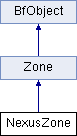
Players return flags to a NexusZone in a Nexus game.
Member Functions | |
| NexusZone() | |
| Constructor. | |
| NexusZone(polyGeom) | |
| Constructor. [details] | |
| containsPoint(p) | |
Check whether p lies inside of this Zone. [details] | |
| getGeom() | |
| Returns an object's geometry. [details] | |
| getId() | |
| Gets an object's user assigned id. [details] | |
| getObjType() | |
| Gets an object's ObjType. [details] | |
| getOwner() | |
| Gets an object's owner as a PlayerInfo. [details] | |
| getPos() | |
| Gets an object's position. [details] | |
| getTeamIndex() | |
| Gets the index of the object's team. [details] | |
| isOpen() | |
| isSelected() | |
| Determine if an object is selected in the editor. [details] | |
| removeFromGame() | |
| Removes the object from the current game or editor session. [details] | |
| setClosedTime(seconds) | |
| Set the time (in seconds) that the Nexus will remain closed. [details] | |
| setGeom(geometry) | |
| Sets an object's geometry. [details] | |
| setId(id) | |
| Sets an object's user assigned id. [details] | |
| setOpen(open) | |
| Set whether the Nexus is open or close. [details] | |
| setOpenTime(seconds) | |
| Set the time (in seconds) that the Nexus should remain open. [details] | |
| setOwner(playerName) | |
| Sets the owner of the object. [details] | |
| setPos(pos) | |
| Set the object's position. [details] | |
| setSelected(selected) | |
| Set whether an object is selected in the editor. [details] | |
| setTeam(teamIndex) | |
| Assigns the object to a team. [details] | |
Detailed Description
Players return flags to a NexusZone in a Nexus game.
NexusZone represents a flag return area in a Nexus game. It plays no role in any other game type. Nexus opening and closing times are actually game parameters, so these methods serve only as a convenient and intuitive way to access those parameters. Therefore, modifying the opening/closing schedule or status of any NexusZone will have the same effect on all NexusZones in the game.
Constructor Documentation
◆ NexusZone.new()[1/2]
| returns NexusZone |
◆ NexusZone.new(polyGeom)[2/2]
Member Function Documentation
◆ containsPoint(p)
|
inherited from Zone | ||||||
Check whether p lies inside of this Zone.
Determines if p is contained by this zone, according to the winding number algorithm. Points which lie on boundary of the polygon are considered inside of it. If a polygon is self-intersecting, this method will return true as long as p lies within some non-self-intersection subpolygon.
- Parameters
-
p The point to check.
- Returns
trueifplies within the zone,falseotherwise
◆ getGeom()
|
inherited from BfObject | |||||
Returns an object's geometry.
- Returns
- A geometry as described on the Geom page
◆ getId()
|
inherited from BfObject | |||||
Gets an object's user assigned id.
Users can assign an id to elements in the editor with the ! or # keys. Use this function to obtain this id. If the user has not assigned an object an id, getId() will return a negative id that will remain consistent throught the game.
- Returns
- The object's id.
◆ getObjType()
|
inherited from BfObject | |||||
Gets an object's ObjType.
See ObjType for a list of possible return values.
- Returns
- The object's ObjType.
◆ getOwner()
|
inherited from BfObject | |||||
Gets an object's owner as a PlayerInfo.
Some objects (like projectiles) have an owning player associated. This method returns a PlayerInfo object if there is an owner. Otherwise, returns nil.
This method is intended to be used with bullets and other projectiles, not with game objects like zones.
- Returns
- A PlayerInfo representing the object's owner, or nil.
◆ getPos()
|
inherited from BfObject | |||||
Gets an object's position.
For objects that are not points (such as a LoadoutZone), will return the object's centroid.
- Returns
- A Point representing the object's position.
◆ getTeamIndex()
|
inherited from BfObject | |||||
Gets the index of the object's team.
Many BfObjects (such as TestItems) are never part of any particular team. For these objects, this method will return Team.Neutral.
- Note
- Remember that in Lua, indices start with 1!
- Returns
- Team index of the object.
◆ isOpen()
| returns bool |
- Returns
- The current state of the Nexus.
truefor open,falsefor closed.
- Note
- Since all Nexus items open and close together, this method will return the same value for all Nexus zones in a game at any given time.
◆ isSelected()
|
inherited from BfObject | |||||
Determine if an object is selected in the editor.
This is useful for editor plugins only.
- Returns
- Returns
trueif the object is selected,falseif not.
◆ removeFromGame()
|
inherited from BfObject | |||||
Removes the object from the current game or editor session.
May not be implemented for all objects.
◆ setClosedTime(seconds)
| Arg types: seconds: int | returns nothing |
Set the time (in seconds) that the Nexus will remain closed.
Pass 0 if the Nexus should never open, causing the Nexus to remain closed permanently. Passing a negative time will generate an error.
- Parameters
-
seconds Time in seconds that the Nexus should remain closed.
- Note
- Since all Nexus items open and close together, this method will affect all Nexus items in a game.
Also note that in a level file, closing times are specified in fractions of minutes, whereas this method works with seconds.
◆ setGeom(geometry)
|
inherited from BfObject | ||||||
Sets an object's geometry.
- Parameters
-
geometry The object's new geometry.
Note that not all objects support changing geometry if the object has already been added to a game.
◆ setId(id)
|
inherited from BfObject | ||||||
Sets an object's user assigned id.
Users can assign an id to elements in the editor with the ! or # keys. Use this function to set this id from Lua. When called from an editor plugin, the value passed will be displayed in the editor when the player presses ! or #.
◆ setOpen(open)
| Arg types: open: bool | returns nothing |
Set whether the Nexus is open or close.
- Parameters
-
open trueto open the Nexus,falseto close it.
- Note
- Since all Nexus items open and close together, this method will affect all Nexus items in a game.
◆ setOpenTime(seconds)
| Arg types: seconds: int | returns nothing |
Set the time (in seconds) that the Nexus should remain open.
Pass 0 if the Nexus should never close, causing the Nexus to remain open permanently. Passing a negative time will generate an error.
- Parameters
-
seconds Time in seconds that the Nexus should remain open.
- Note
- Since all Nexus items open and close together, this method will affect all Nexus items in a game.
◆ setOwner(playerName)
|
inherited from BfObject | ||||||
Sets the owner of the object.
- Parameters
-
playerName Name of player as a string.
- Note
- This method only works if the item in question has already been added to the game via addItem(object). The owner cannot be set beforehand. Also, 'playerName' must exactly match a the name of a player already in the game (case-sensitive).
This method is intended to be used with bullets and other projectiles, not with game objects like zones.
◆ setPos(pos)
|
inherited from BfObject | ||||||
Set the object's position.
To set the full geometry of a more complex object, see the setGeom() method.
- Parameters
-
pos The new position of the object.
◆ setSelected(selected)
|
inherited from BfObject | ||||||
Set whether an object is selected in the editor.
This is useful for editor plugins only.
- Parameters
-
selected trueto select the object,falseto deselect it.
◆ setTeam(teamIndex)
|
inherited from BfObject | ||||||
Assigns the object to a team.
- Parameters
-
teamIndex Index of the team the object should be assigned to. (first team index is 1; there is no team 0)
Instead of a team index, you can use the special team enums Team.Neutral and Team.Hostile.
Limitations: